
প্রচ্ছদ » অন্যান্য » বিস্তারিত
The Codebreaker: Redoyan Chowdhury’s Mission to Outwit Financial Fraud
২০২৫ নভেম্বর ১৭ ২৩:৫৫:০২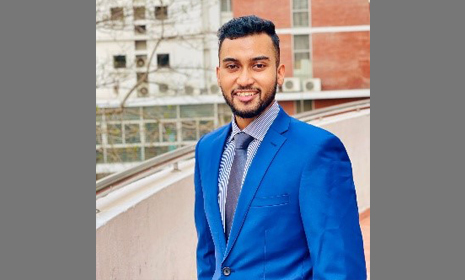
Where algorithms outsmart adversaries.
When hackers siphoned nearly $81 million from Bangladesh Bank’s U.S. reserves via the Federal Reserve Bank of New York in 2016, a young student in Dhaka was watching closely. The breach didn’t just shake Bangladesh’s financial system it lit a fire under Redoyan Chowdhury.
Now, nearly a decade later, Chowdhury sits at the center of a technological revolution from his Los Angeles office. Armed with machine learning models and patent, the Bangladeshi-born researcher is tackling a colossal American problem: financial fraud that cost U.S. consumers $12.5 billion in 2023 alone.
“Fraudsters are evolving faster than the systems meant to stop them,” Chowdhury said. “To beat them, we have to think like them but smarter.”
From Dhaka to Disruption
Chowdhury’s journey from the lecture halls of Ahsanullah University of Science and Technology in Dhaka to the boardrooms of U.S. fintech firms is anything but typical. A former physics olympiad finalist (2015) and also National Earth Olympiad finalist (2014), he pursued a BBA degree in finance before moving to the United States for his MBA in Management Information Systems at International American University in Los Angeles.
His studies didn’t stop in the classroom. Inspired by cybercrime headlines, Chowdhury began exploring AI and machine learning taking online courses, building models, and poring over global financial datasets. His passion solidified into a research thesis that’s now turning heads across the banking sector: “Machine Learning-Based Detection and Analysis of Suspicious Activities in Bitcoin Wallet Transactions in the USA.”
That work soon evolved into a unified platform that does more than just flag fraud. It predicts and prevents it faster, smarter, and at scale.
Smarter Than the Scammers
Traditional fraud detection systems operate like static gatekeepers, using rules and red flags that criminals quickly learn to dodge. Chowdhury’s approach is different. His system, powered by deep learning, Q-learning, and Graph Neural Networks, doesn’t wait for fraud to occur it adapts in real time.
“Our model updates itself based on every new threat it sees,” he said. “That’s how we stay ahead.”
Tested against FDIC datasets and real bank transactions, Chowdhury’s system boasts a 94% fraud-detection rate leaps ahead of the 71% industry norm. In one trial, it caught a cryptocurrency fraud ring in less than 48 hours. The bank involved credited the system with saving $2.3 million.
But the innovation goes beyond fraud. Chowdhury’s predictive tools, trained using ensemble learning methods and transformer-based NLP like FinBERT, forecast market behavior with 87% accuracy. It’s the kind of foresight that could transform how institutions plan for recessions, allocate resources, and manage risk.
National Stakes, Global Vision
His work aligns directly with Executive Order 14179, which prioritizes AI as a strategic national asset. Chowdhury’s proposed AI overhaul could trim the $45 billion in annual inefficiencies plaguing U.S. financial systems, according to a 2024 Federal Reserve report.
Chowdhury has already secured intellectual property rights in the U.K. (Computer device for business process optimization and decision making, Design number: 6442306) and Canada (AI-Enhanced Business Analytics: Unlocking the Power of Data, Registration Number: 1231798) and serves as a peer reviewer and editorial board member on journals. His broader research includes AI’s role in healthcare, generative AI for business innovation, and the socio-economic impacts of microcredit.
The Road Ahead
Chowdhury isn’t stopping at innovation he’s also building the next generation of talent. His 10-year roadmap includes training 10,000 AI professionals to close the workforce gap and prepare U.S. agencies for real-time digital defense.
His ultimate goal: integrate AI systems into both public and private financial sectors, with applications at the Department of the Treasury, Federal Reserve, and state-level regulators. Plans include building federated AI dashboards for public use, Apache-powered fraud trackers, and AI-driven forecasting tools.
“Financial security is more than just stopping scams,” he said. “It’s about rebuilding trust, ensuring transparency, and staying ahead of global threats.”
In an age where algorithms often feel cold and opaque, Chowdhury stands out not just for his technical brilliance, but for his mission-driven clarity.
Search Redoyan Chowdhury on: www.googlescholar.com, www.ResearchGate.net etc.